For years, your printers have been sending scanned documents via email using Microsoft’s SMTP protocol. It worked, so no one changed anything.
But this model is disappearing. Microsoft is transitioning so-called HVE (High Volume Email) accounts—those used for automated bulk email—to a pay-as-you-go billing model, and the planned technical replacement, OAuth 2, does not support all devices.
At Infologo, an IT service provider based in Lausanne and Geneva, we’re already handling several client situations affected by this change, and the same question comes up time and time again: “How much will I have to pay? And who’s keeping an eye on things?”
What Microsoft Is Changing
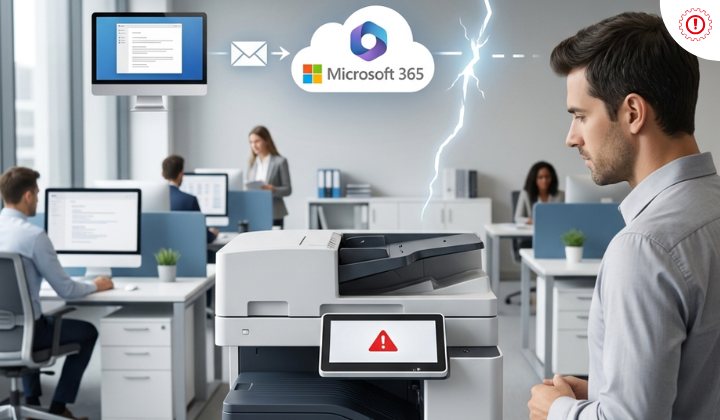
Traditional authenticated SMTP allowed a printer, business software, or mail server to use a Microsoft 365 mailbox to send emails without human intervention. Microsoft is now moving toward OAuth 2, a more secure authentication protocol, and transitioning HVE mailboxes to a pay-per-message-sent or pay-per-recipient model.
The change is now in effect. Customers who are still using SMTP for their automated mailings will be affected in the coming weeks.
So the question isn’t whether this will change, but rather what the situation is for each piece of equipment.
A common mistake: believing that a printer’s age is a reliable indicator
OAuth 2 compatibility cannot be inferred from the hardware’s purchase date. This is the point that most customers overlook, and it’s understandable, because intuition suggests the opposite.
We saw a several-year-old Ricoh C3000 at a client’s site in Gemevois switch over to OAuth 2 without any issues. The firmware had been kept up to date, and the manufacturer had added support in time. Conversely, some newer devices do not yet support this protocol, either because the manufacturer has not released an update or because the update exists but has not been applied.
The result: you have to take inventory item by item. Not by equipment category, not by brand, not by year. Item by item.
What this means for billing
For OAuth 2-compatible printers, the migration is technical and relatively straightforward, even though it requires action on each device.
For everyone else, the fallback solution involves an HVE box. And that’s where the model changes. Instead of a fixed cost included in the Microsoft 365 license, you switch to pay-as-you-go Azure billing. The amount varies each month based on the actual volume of mailings and is billed directly to the Azure account of the service provider managing the environment.
This model poses two practical problems for an SME.
First, clarity: a billing line item that fluctuates every month without a clear explanation raises questions.
Next, monitoring: if usage skyrockets because an automated process goes haywire or a user is downloading abnormally large amounts of data, no one notices until the bill arrives.
What we recommend at Infologo
The best approach for HVE customers is to charge a fixed monthly fee rather than passing on variable Azure billing costs as-is. An amount of around 5 CHF per month per customer covers administrative costs and provides a level of transparency that pay-as-you-go billing does not.
This flat-rate plan must include a note on the invoice specifying the average volume of shipments covered. If a customer’s usage significantly exceeds this baseline, this allows us to contact them with concrete data rather than an unexplained price increase.
For teams managing multiple clients, the top priority is to compile an inventory: for each client, list the printers and multifunction devices that are switching to OAuth 2 and those that are switching to HVE. This task doesn’t take very long if it’s organized properly, but it can’t be done in bulk. You have to go through each device individually.
Of all the customer environments we recently reviewed, fewer than half had an up-to-date inventory of their printing fleet that included OAuth 2 compatibility status. This is the first blind spot that needs to be addressed.
What remains to be confirmed
The exact mechanisms for Azure HVE provisioning and rebilling are currently being clarified with the distributors. Internal communication among IT service providers should stabilize in the coming weeks. What remains unchanged: the need to take inventory now, before existing SMTP servers stop working or the first unexpected Azure invoices arrive.
If you haven’t yet checked the status of your printers, please contact us to review your fleet.