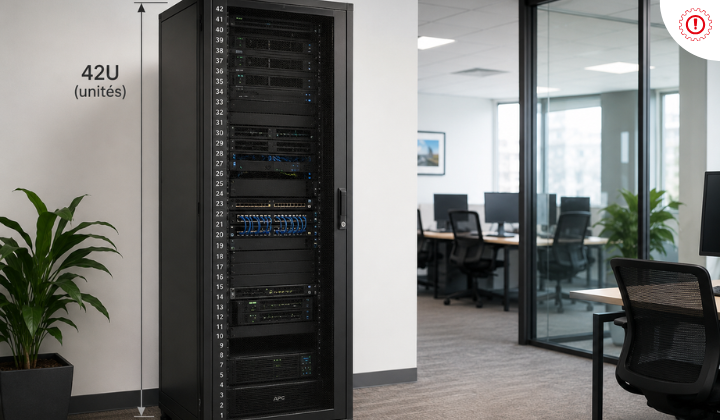
A 42-unit rack in a meeting room or office hallway takes up space, generates heat, and produces constant background noise that everyone has learned to ignore—except for new employees.
At Infologo, an IT service provider based in Geneva and Lausanne, we regularly see this setup at small and medium-sized businesses in French-speaking Switzerland that have grown quickly and never formalized their infrastructure. The rack has been there for ten years, one-third full, and no one dares to touch it.
However, there is one type of solution that most service providers do not mention off the top of their heads: the soundproof rack on casters.
What This Means in Practice
A soundproof rack on casters is a closed server rack equipped with an acoustic enclosure that absorbs noise from the fans. It can be moved without tools, requires no drilling into walls, and can be plugged into a standard outlet depending on the power requirements of the equipment. The noise reduction is significant: some models operate at less than 45 dB under load, which is equivalent to the level of a quiet conversation.
A client in the energy sector contacted us with exactly this request: to replace a 42U rack with something better suited to their current equipment—namely, a single 11U tower server and a few networking accessories. The original rack was oversized and noisy, and the client wanted to avoid major electrical work at all costs.
The solution chosen: a 38U soundproof CX-series rack on casters, with our team handling the migration of all equipment.
Estimated cost: around 4,600 CHF. “Insulation comes at a cost,” he was told, and he accepted that without hesitation once he realized what he was avoiding.
The Tower Server in a Rack: Two Options to Know About
A tower server does not fit directly into a standard rack. There are two ways to install it neatly, and the choice depends on the rack’s depth and the available space.
The first option is to lay the server flat on a tray mounted in the rack. It’s simple, inexpensive, and works if the model allows it (check the manufacturer’s documentation: some HP servers support this position, while others do not).
The second option is to use a tower-to-rack converter, a mechanical component that allows you to mount the case vertically like a standard rack unit. It costs a little more but provides a cleaner look and makes thermal management easier.
In both cases, the issue of the patch panel warrants consideration before ordering anything: Is it removable? Can it be moved to the new location as-is? Is the cable routing in the new rack compatible with the depth of the rails?
These points should be verified before placing an order, not after delivery.
What Infologo Supports and What We Don’t Do
Infologo can provide the rack, coordinate the physical relocation of the equipment, reconnect the patch panel, and ensure that everything is brought back online in the correct order. That’s exactly what we did for a client in a similar setup, and the client was satisfied with the results from the very first week.
What we don’t do: drill into load-bearing walls, run new recessed electrical cables, or modify an electrical panel. These tasks must be performed by a licensed electrician. The line is clear, and explaining this honestly helps avoid unpleasant billing surprises.
In most cases involving the replacement of a rack in an existing office, an electrician is not needed: the new rack simply plugs into the same outlet as the old one.
What we recommend at Infologo
Before ordering a rack, check three things:
- the usable depth of the rails (not just the external depth of the rack),
- the type of patch panel currently in use,
- the server’s temperature tolerance when placed in a horizontal position, if you are considering this option.
When it comes to noise, a soundproof rack of decent quality starts at around 3,500 to 4,600 CHF, depending on the size. It’s a one-time investment that provides a lasting improvement in working conditions and delays the need for a dedicated server room.
For an SME with a single physical server, a switch, and a NAS, an 18- to 30U rack is generally sufficient. Upgrading to 38U provides room to grow without having to relocate your infrastructure again. If your current server is supported through 2029 and its resources meet your VM needs, there’s no reason to replace it—simply changing the enclosure is enough.
If you have an oversized rack in your office and would like to explore replacement options, contact us for a no-obligation assessment.